It is the most expensive question we get asked, and it almost always arrives the same way: someone buys a flat in Alicante or inherits a villa on the coast, switches the air conditioning on for the first time and everything trips. Or they look at the consumer unit and a neighbour tells them "that lot needs replacing". Two doubts follow. Does all of it really need replacing, or only part? And if it does, what does it cost, how long does it take, and do we have to move out?
This guide answers all three the way we assess a job on site. It does not start by selling a full rewire, because plenty of homes do not need one: there is a very reasonable middle ground between "leave it alone" and "chase out every wall", and working out which of the three scenarios your property is in is what decides the quote.
The three possible scenarios — only one is a full rewire
Almost every property we survey falls into one of these:
| Scenario | What is done | When it applies |
|---|---|---|
| Upgrade the protections | New consumer unit with RCDs and a breaker per circuit, cabling untouched | Cable is sound and of adequate cross-section, there is a real earth, circuits are already separated |
| Partial rewire | New unit plus rebuilding the critical circuits (kitchen, washing machine and water heater, air conditioning, bathrooms) and adding an earth | Most of the installation is serviceable, but specific runs are undersized or unsafe |
| Full rewire | Everything new: runs, boxes, accessories, unit and earthing | Degraded or aluminium cable, no real earth, one or two circuits feeding the whole home, joints outside boxes |
The cost difference between the first and the third is an order of magnitude. That is why the first step is never a quote over the phone: it is opening the consumer unit, taking measurements and looking at the actual condition of the cable in several places. If someone offers you a "complete rewire" without having entered the property, they are selling you the most expensive scenario by default.
If your doubt is only about the consumer unit, that case is covered separately in when to replace the consumer unit and what a new consumer unit costs in Alicante.
The signs that genuinely call for a full rewire
These stop being a matter of opinion once they appear. With two or three of them together, a full rewire is almost always the sensible answer:
- There is no earth. Two-pin sockets with no side contacts, or sockets with contacts but no earth conductor behind them. Very common in pre-1980s property, and fitting new sockets does not fix it.
- Aluminium cable. It expands, loosens terminals and runs hot. In a home there is no reasonable partial fix.
- Cracked, brittle or yellowed insulation, or cable with fabric and rubber sheathing. Handling it makes it crumble: every intervention opens a new fault.
- One circuit, or two, for the whole home. That is the signature of an old installation. It means the washing machine, the oven and the lighting share a protective device, and any fault puts the whole property in the dark.
- Undersized conductors. 1.5 mm² cable feeding general-purpose sockets, or the kitchen hanging off the same run as the lights.
- Joints outside boxes, connector blocks dangling, boxes with no lid scattered around: that is not one local defect, it is how the whole installation was built.
- Warm sockets or switches, dark marks around an accessory, a smell of hot plastic. That is contact resistance at work, and it warns you once.
- A ceramic-fuse or bakelite board with no RCD. No RCD means no protection against electrocution, and that is the cut-off point.
And one that is invisible inside the home but weighs just as much: the installation has no certificate and the distributor is asking for one. Once an installation passes twenty years without being updated, a fresh certificate is routinely required to take over the supply or change the contracted power, and a registered installer cannot sign one over an installation that does not comply. The whole process is in our guide to the Spanish electrical certificate (CIE).
What the regulations actually require: the electrification level
This is the part almost nobody explains, and it determines how many runs have to be pulled — and therefore much of the price. Spain's low-voltage regulation (REBT) defines a basic electrification level (5,750 W) and a high one (9,200 W) for dwellings, and each carries a minimum number of independent circuits.
At basic level a home must have at least five separate circuits:
| Circuit | What it feeds | Minimum cross-section |
|---|---|---|
| C1 | Lighting | 1.5 mm² |
| C2 | General-purpose sockets and fridge | 2.5 mm² |
| C3 | Hob and oven | 6 mm² |
| C4 | Washing machine, dishwasher and water heater | 4 mm² |
| C5 | Bathroom and kitchen worktop sockets | 2.5 mm² |
At high level — which is what any home with air conditioning, an induction hob and some electric heating needs today — you add dedicated circuits for additional lighting and sockets, heating, air conditioning, a tumble dryer and automation, plus duplicates of the circuits above once the floor area requires it.
Two practical consequences of that table:
- A 1970s flat with two circuits is not brought up to date by adding sockets. It is missing entire runs from the consumer unit, and that means new cable to every zone.
- The number of points per circuit is capped too. You cannot hang twenty sockets off one run just because the breaker physically allows it: there is a maximum per circuit, and respecting it is part of what you are paying for.
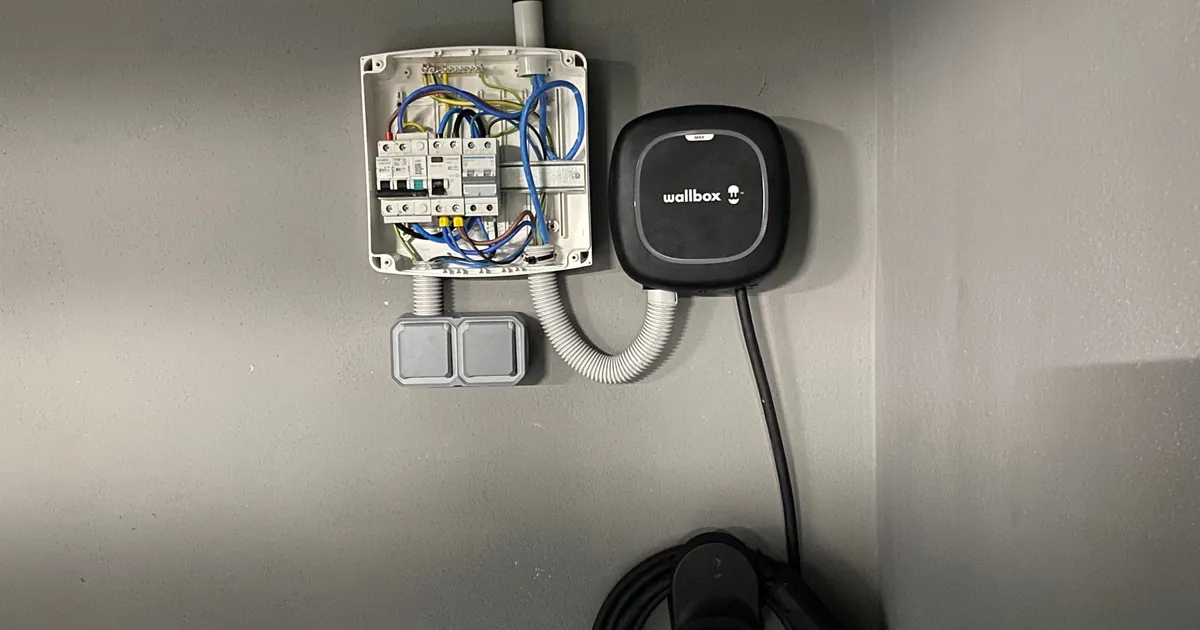
If you are also going to fit an electric car charger, that circuit has its own technical instruction and its own protective devices — decide it before the rewire, not after. It is explained in EV charger installation, and the same applies to air conditioning in electrical work for air conditioning.
Does every wall have to be chased out?
This is the question that really stops people, and the honest answer is: it depends on whether the current installation runs in conduit, and what condition that conduit is in.
- Sound conduit: new cable can be pulled through the existing route, using the old cable to draw it. Chasing is limited to new boxes or runs going somewhere that never had one. This is the common case in 1980s and 1990s property, and it is what makes rewiring a furnished home viable.
- Crushed, broken or non-existent conduit (cable buried straight into the plaster, typical of older construction): there is no way to pull new cable without cutting chases. Here there is building work, and you need to budget for plastering and painting.
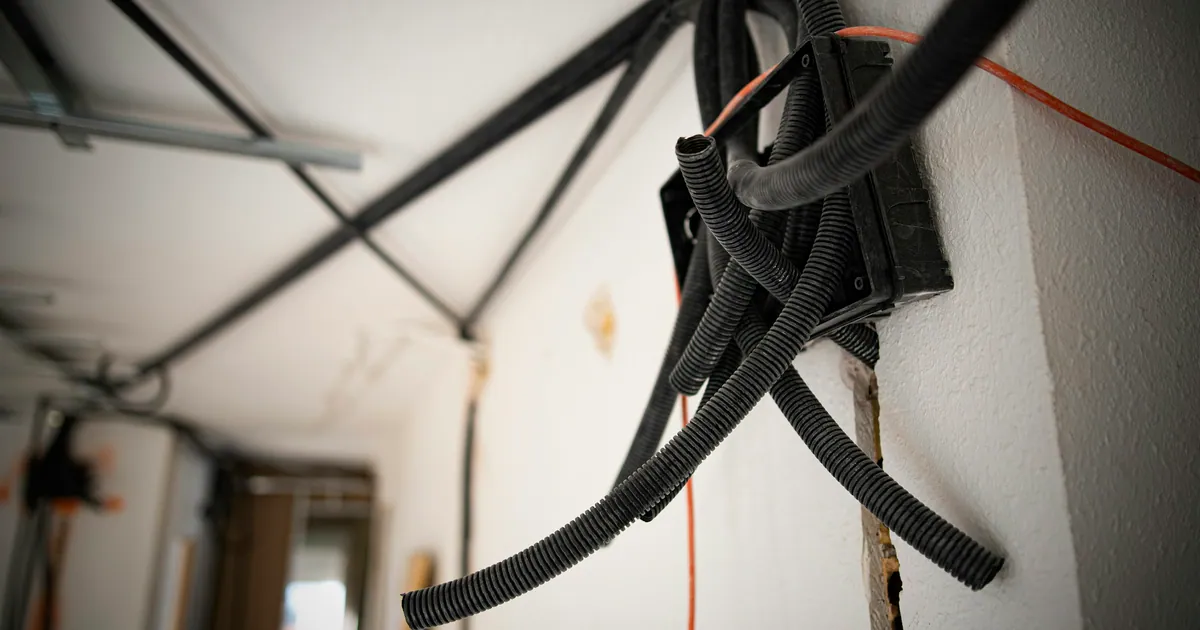
- Surface, no building work: trunking, moulding or a wiring skirting. This is the answer for finished homes where nobody wants to touch the decoration, for stone houses in inland villages, and for phased renovations. Visually it is a decision, not a bodge: set out properly it reads cleanly, and it can be buried later.
- Through a suspended ceiling or raised floor: if the home already has one, most of the horizontal route is solved there and the chasing is reduced to vertical drops.
All of this is checked on a first visit with two or three accessories taken off the wall. That is where the real quote comes from — and also the answer to whether you can stay in the house during the work.
How it is done, step by step
- Survey, measurements and scope. Cable condition, continuity and earth resistance, insulation testing, available power and what containment exists. This is what decides which of the three scenarios applies.
- Circuit design. How many runs, which electrification level, where the unit goes and what is being allowed for in future (a charger, a heat pump, panels, air conditioning). Allowing for a run you will not use for two years costs a fraction of what it will cost later.
- Containment. Chases, conduit or surface trunking, and accessible junction boxes. Boxes must stay accessible: a plastered-over junction box is a guaranteed future fault.
- Cable pulling and the new consumer unit. Runs from the unit to each zone, with a main switch, the appropriate RCDs and a breaker per circuit. This is also where you decide whether surge protection goes in — strongly advisable in storm-prone areas.
- Earthing. Rod or rods, a protective conductor to every point, and supplementary bonding in bathrooms and the kitchen. More on this below.
- Accessories and light fittings. Sockets, switches, lighting points. This is the natural moment to rethink the lighting, because the cable is already open: see LED lighting.
- Testing and certification. Continuity, insulation resistance, RCD trip times, earth measurement, polarity. With those results in hand the electrical certificate (CIE) is issued and the installation is registered. Without that last part the job is not finished.
How long it takes, and whether you can stay
It depends on the scope, and the range is wide because the three scenarios are different jobs:
- A consumer unit swap is a matter of hours and the property is back in service the same day.
- A partial rewire runs to days, with the power off zone by zone rather than for the whole house at once.
- A full rewire with chasing is building work. An empty property goes much faster; an occupied one can be done in phases, but it stretches out, because each day has to end with lighting and at least one socket circuit back in service.
One thing we always organise the same way: no home is left without a fridge or without light at the end of the day, and areas under work are left dead and marked. If the property is occupied, say so from the outset — it changes the order of the work, not the price.
What drives the price
There is no meaningful price per square metre, because two identical flats can cost double one another. What moves the figure:
- The scope (the three scenarios above). This dominates everything else.
- The number of circuits, which follows from the electrification level and the floor area, not from anyone's preference.
- Containment: reusing existing conduit versus cutting chases and making good. Plastering and painting come in here, and sometimes cost more than the electrical work.
- The distance from the unit to the far corners of the property, and whether it has to be relocated.
- Earthing: driving rods at a villa is not the same job as at a third-floor flat with no ground of its own.
- The accessories and fittings chosen — the one line where the client freely decides the spend.
- Certification and registration, and whether a change of contracted power is involved.
As an indicative reference for the province of Alicante, always to be confirmed after the visit: a complete rewire of a flat of around 90 m² starts at €1,500 and reaches €3,500 including the certificate; a new consumer unit from €350; renewing the earthing between €150 and €400; the electrical certificate from €150; and a pre-purchase inspection between €60 and €90. A large detached house, with more area and longer cable runs, goes above that range proportionally.
Be wary of two things: a fixed price given over the phone, and a price "per point" that does not say what a point includes. That format hides exactly the expensive parts — the runs from the consumer unit, the earthing and the certificate.
What the quote must contain, so you can compare quotes
Ask for these in writing. When two quotes differ sharply, the difference is almost always in one of them:
- The number and type of circuits to be pulled, with cross-sections.
- Consumer unit: main switch, how many RCDs and at what sensitivity, a breaker per circuit, and whether surge protection is included.
- Earthing: whether it is being renewed, whether it is measured, and what value is guaranteed.
- Containment: existing conduit reused, new chases or surface, and who makes good the plaster and paint.
- Accessories: brand, range and quantity. This is where a cheap quote is most often dressed up.
- Electrical certificate (CIE) included, with the registered installer's number.
- Timescale, payment terms and warranty.
How to pick a firm is set out in choosing an electrician in Alicante. The non-negotiable point: whoever signs the certificate has to be a registered installer, and you check that before the work starts, not after paying.
Earthing: the part most often skipped
In a full rewire this is where there is the biggest gap between doing it and appearing to do it. An RCD protects behind an earth that works; without a protective conductor reaching every point, a three-pin socket is decoration.
What we do: a rod or rods depending on the ground, a protective conductor to every circuit, supplementary bonding in the bathroom and kitchen, and a measurement of the resistance with the RCD in place, to confirm the touch voltage stays under the regulatory limit. That value is recorded; it is not an opinion.
On the coast there is an added reason. The salt air of Playa San Juan, El Campello, Santa Pola, Torrevieja and Guardamar corrodes terminals and connections, and in properties with a pool, irrigation or an exposed terrace, earthing stops being a formality. It is covered in the earthing and bonding service.
Particular cases around the province
- A second home that gets let. Absolute priority to RCDs, earthing and weatherproofing outdoors: the property will spend months with nobody there to notice an early symptom.
- A flat in a block. Your individual supply cable and your consumer unit are yours; the meter room and the building's main board belong to the community. Work out which side the problem is on before quoting — it relates to electrical maintenance for communities.
- A villa with a pool, irrigation or a borehole. Independent circuits and reinforced outdoor protection. A rewire is the moment to separate them, not to leave them hanging off the house run.
- A commercial unit being converted into a dwelling. That is not a renovation, it is a new installation with its own procedure. It almost always needs a designed project, not just a certificate.
- A property you have just bought. If you have not signed yet, a pre-purchase inspection is worth far more than it costs: see checking the wiring before you buy.
Frequently asked questions
Can a rewire be done in phases? Yes, and in an occupied home it is usually the best way. You start with the consumer unit and the critical circuits — kitchen, washing machine and water heater, bathrooms — and continue with the rest. What cannot be phased is the certificate: it is issued over what is finished.
Do the sockets and switches have to be changed too? In a full rewire, yes: old accessories have no earth contact and their terminals have been working for decades. In a partial rewire, the ones on the runs being rebuilt are changed.
Can existing cable be reused if it is in good condition? Sometimes, and that is established by testing insulation resistance, not by looking at it. What is never reused is aluminium cable, fabric-sheathed cable, or cross-sections below what the circuit requires.
Does the contracted power have to go up? Not necessarily. Rewiring and increasing contracted power are separate things: many homes end up far better distributed on the same supply. If it does go up, a certificate has to be issued, and that step belongs in the same quote.
Does the electrical certificate last forever? It certifies the state of the installation at the moment it is issued. It remains valid while the installation is not modified, but any later work that changes circuits requires a new one.
What if I only want to know whether my installation is sound? That is an inspection, not a renovation, and it is settled in one visit: see home electrical inspection.
In short
Before you accept any figure, find out which of the three scenarios your property is in: protections, partial rewire or full rewire. That is decided by opening the consumer unit and measuring, not over the phone. Then check that the quote states how many circuits are being pulled, how they are contained, who makes good, what happens to the earthing and whether the certificate is included. With those five facts, two quotes finally become comparable.
At ElectriPro Alicante we carry out complete electrical installations and rewires across Alicante and the Costa Blanca, certificate included, in Spanish, English, Russian and Ukrainian. See our electrical installation, consumer unit and electrical certificate services, or ask us for a survey. If what you have is a fault that cannot wait, here is the emergency electrician.
Been told the whole installation needs replacing?
Before you accept a figure, we open the consumer unit and measure: we tell you whether upgrading the protections is enough, whether it is a partial rewire, or whether a full one is genuinely due. Certificate included.
See electrical installation