Almost every client who contacts us about a charger arrives with the same question and the same fear. The question is how many kW to install. The fear is that doing so will mean increasing the contracted power and paying more on the electricity bill every month for years. Let's take both, because in most cases the answer is more reassuring than people expect.
Start with how much charge you actually need
Before looking at equipment, look at your routine. In round numbers, an electric car uses 15 to 20 kWh per 100 km. If you drive 50 km a day, you need to put back around 8-10 kWh each night.
With that in hand, the comparison is revealing:
| Power | Type | kWh in 8 hours | Range added overnight |
|---|---|---|---|
| 2.3 kW (standard socket) | Single-phase | ~18 kWh | ~100 km |
| 7.4 kW | Single-phase | ~59 kWh | Full battery |
| 11 kW | Three-phase | ~88 kWh | Full battery |
| 22 kW | Three-phase | ~176 kWh | Full battery |
The conclusion is inconvenient for anyone who wants the biggest unit: at 7.4 kW, one ordinary night already fills the entire battery of nearly any car on the market. Going to 11 or 22 kW does not give you more kilometres per day, it only fills up sooner — which matters only if you need to top up mid-afternoon before heading out again.
That is why, for a home, 7.4 kW single-phase is the right choice in the great majority of cases — not to save money, but because it matches real use.
Single-phase or three-phase: in Alicante this is usually already decided
Most homes in Alicante and along the Costa Blanca have a single-phase supply at 230 V. An 11 or 22 kW charger requires a three-phase supply. If your home is single-phase, 22 kW is not merely expensive — it simply cannot be installed without changing the service connection, a process with the distribution company that costs considerably more than the charger itself.
You can check this yourself in a minute: look at your bill or your panel. If the main switch (ICP or IGA) has two poles, you are single-phase. If it has four, you are three-phase. Detached houses, industrial units and some older buildings do commonly have three-phase.
One detail that gets forgotten: the car has a say too. Many models have an onboard charger limited to 7.4 or 11 kW. If your vehicle accepts 11 kW maximum, a 22 kW point will not charge it one minute faster. Check the car's specification before deciding.
The real fear: do I have to increase my contracted power?
This is the question that stops more installations than any other, and it deserves an answer with numbers.
Picture a home with 5.75 kW contracted, which is very common. Add a 7.4 kW charger running flat out and the theoretical total is 13.15 kW — far above what is contracted. If the oven and the air conditioning happen to be on that evening, the main breaker trips and the whole house goes dark.
The solution is not to increase the contracted power. The solution is called dynamic load management.
A small meter is fitted in the main panel to measure in real time what the home is drawing. The charger reads that figure and adjusts its own power on the fly: switch on the hob and the charger steps down automatically; when cooking finishes, it ramps back up. The contracted power is never exceeded, the breaker never trips, and the car keeps charging all night at whatever power is spare.
In practice this means the vast majority of our clients install a charger without touching their contracted power, and without paying a cent more in standing charges. The extra cost of the meter is small next to years of a higher contracted-power tariff.
Increasing does make sense in two specific cases: when the home was already tight on power before the car, and when two electric vehicles regularly charge at the same time.
Protections are not an optional extra
A charger is not hung off an existing socket. It needs its own installation, and this is neither optional nor negotiable:
- A dedicated circuit from the panel, with cable cross-section sized for the current and the length of the run.
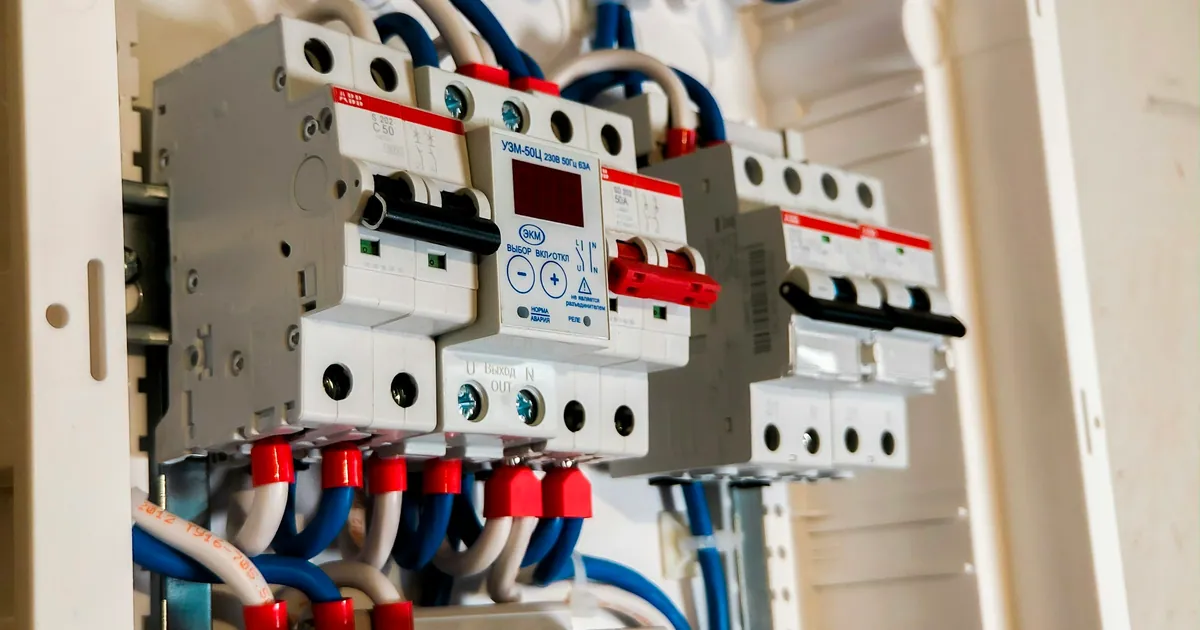
- Its own circuit breaker, calculated for the charger.
- A suitable residual-current device, type A-EV or equivalent, able to detect DC leakage currents that a conventional RCD cannot see. This is the point most often skipped in cheap installations.
- Correct, verified earthing. If the home's earth is poor, it must be fixed first: this is the protection that stops the car's chassis becoming live. More on our earthing and grounding in Alicante page.
- Surge protection, advisable especially where summer storms are frequent, to avoid losing the electronics in both charger and car. We cover it under surge protection.
If a quote mentions neither earthing nor a specific RCD, it is not a cheap quote — it is an incomplete one.
What else to check before buying
- Tethered cable or type 2 socket. A fixed cable is more convenient day to day; an open socket lets you use different cables and is handier if you change cars.
- Connectivity and control. Wi-Fi or Bluetooth to schedule charging during your tariff's off-peak hours. A large share of the real saving lives here: charging overnight rather than at peak times changes the bill substantially.
- RFID authentication. Essential in a communal garage or wherever the point is accessible to others.
- IP rating. If the charger sits outdoors or on an open porch, check the IP rating and UV resistance; on the Costa Blanca, sun and sea air are harder on equipment than people expect.
- Solar surplus compatibility, if you have panels or plan to add them. We develop this in charging your car from solar panels.
We work with proven brands such as Wallbox, ABB, Schneider Electric and Circutor, and we recommend the model that fits your installation, not the one that suits us to sell.
Quick summary
- Work from the kilometres you drive on a normal day, not on holiday.
- Check whether your supply is single-phase or three-phase.
- Check your car's onboard charger.
- For a home, 7.4 kW single-phase is almost certainly what you need.
- Ask for dynamic load management instead of increasing contracted power.
- Insist on a dedicated circuit, an A-EV type RCD and verified earthing.
Want to know what it costs in your case? We break the price down in how much an EV charger costs in Alicante, and explain the current tax relief in which incentives are left in 2026.
See our EV charger installation in Alicante service or request a quote with no obligation. The site visit is free and carries no commitment.
Want to install a charger at home?
We install EV chargers in Alicante and the Costa Blanca, with installation certificate and a closed quote after the visit.
See EV charger installation