There is one call we get a lot now that self-consumption has spread across the province: "my panels are producing less than last year". Sometimes it's an impression — last summer was sunnier, or a new load appeared in the house — and sometimes it's real: a panel is down, a protective device has tripped, or half the array is under a layer of Saharan dust.
The good news is that nearly all the causes are quick to identify, and several cost nothing to fix. This guide explains how to check whether your installation is performing as it should, and what holds it back in the specific climate of Alicante and the Costa Blanca.
First: is it actually producing too little?
Before hunting for culprits, you need a reference. In this province, each installed kWp produces in the order of 1,500 to 1,700 kWh a year on a well-oriented, shade-free roof. In other words:
| Installation | Expected annual output |
|---|---|
| 3 kWp | ~4,500 – 5,100 kWh |
| 4 kWp | ~6,000 – 6,800 kWh |
| 6 kWp | ~9,000 – 10,200 kWh |
Two warnings before drawing conclusions:
- Output is not flat across the year. A December day produces less than half of a June day, and that is normal, not a fault.
- Producing less is not always the same as saving less. If your installation exports a lot of surplus, it may be generating well and being used badly. Different problems, different solutions.
The useful comparison is the same month one year against another, and above all one panel or string against another within the same installation: if one half is fine and the other isn't, the diagnosis is already half done.
The 8 most common causes
1. Dirt, dust and calima
The first and the most underestimated. A thin layer of dust costs a small percentage, but in this province the problem isn't ordinary dust: it's the calima episodes, which leave a film of sand that doesn't wash off by itself and which cakes on if muddy rain follows. Installations near the sea add salt deposits, and rural sites add pollen and bird droppings.
A module with persistent staining can lose a noticeable amount — and, more importantly, if the dirt collects along the bottom edge of the panel it can behave like shade: it doesn't take a little off, it drags the whole row down.
2. New shading
The installation was designed without shade, but things change: a new air-conditioning unit, an aerial, a chimney, a railing, a tree that has grown, or the building next door. And winter shade is not summer shade: the sun sits much lower, so an obstruction that doesn't matter in July can cover panels in December.
The typical symptom is a drop that only appears at certain hours — and always the same ones.
3. The inverter in error, or derating from heat
The inverter is the heart of the installation and also its most frequent point of failure. Two scenarios:
- Error or shutdown. Sometimes it has been stopped for days and nobody noticed, because the house still had grid power. If you have a monitoring app, look at it; if not, look at the display.
- Temperature derating. An inverter mounted in direct sun on a south-facing wall, in August at 40 °C, reduces its output to protect itself. This is a very common installation mistake, and the fix is relocating or ventilating it, not replacing it.
4. A panel or a string down
In installations without optimisers or microinverters, panels are wired in series: the worst-performing module sets the pace for the whole chain. A panel with a damaged diode, a loose connector or a crack invisible from ground level can drag down the output of ten others.
When the drop is sudden and roughly half of normal, the first thing we look at is whether an entire string has gone down.
5. Protective devices tripped after a storm
Very typical here in September and October. After a storm with lightning, the DC protection or the inverter's breaker trips and the installation sits idle with no visible warning inside the house. And if there is no surge protection, what the lightning takes isn't the output — it's the whole inverter. We cover it in surge protection.
6. Connections degraded by sun and salt
DC connectors, glands and junction boxes live outdoors, under Alicante sun all year and salt air on the coast. Over time you get loose contacts, oxidation and dried-out insulation. Besides costing output, a loose DC contact is one of the few genuine fire risks in a PV system, so this check is not cosmetic.
7. It isn't production: it's configuration or billing
A whole family of cases we solve without touching a single panel:
- Zero-export limitation or a badly configured export setting, which makes the inverter throttle back when the house isn't consuming.
- Surplus compensation not activated with your supplier, or a contract change that dropped it. Explained in solar panels in Alicante: price, grants and legalisation.
- A wrongly installed or displaced energy meter, which makes the inverter "believe" the house is consuming nothing.
- Changed consumption habits: the same output with the washing machine now running at night produces a worse bill without the installation having got any worse.
8. Real degradation (and misplaced expectations)
Panels do lose performance over the years, but very slowly: in the order of 0.5 % a year on current modules. If your installation is producing 20 % less than two years ago, that is not degradation: it is one of the seven causes above. And if it never reached what was promised, the problem may be in the original sizing or in an over-optimistic savings forecast from whoever sold it.
How we check it
A serious review is not looking at the roof from the ground. What a diagnostic visit involves:
- Reading the monitoring data: history by month, by day and by string, to separate "produces little" from "produces oddly at certain hours".
- Visual inspection of the modules: dirt, fixed staining, hot spots, frames, fixings and the state of the mounting structure.
- DC measurement of voltage and current per string, comparing chains against each other. This is where down panels show up.
- Inverter review: error log, temperature, ventilation and location.
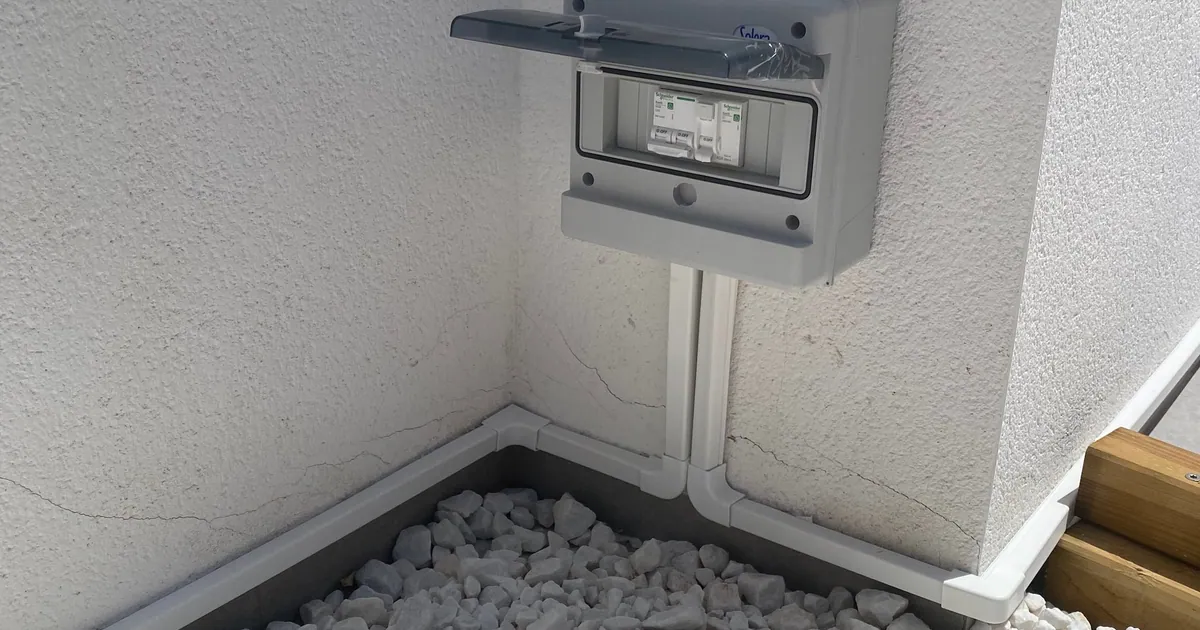
- Protection, earthing and connections: DC and AC, terminal torque, condition of connectors and boxes.
- Configuration: export mode, energy meter, communications and parameters.
At the end we tell you what is going on and what is worth fixing and what isn't. On some installations the answer is half an hour of cleaning; on others a section has to be rebuilt.
Cleaning: when, how and what not to do
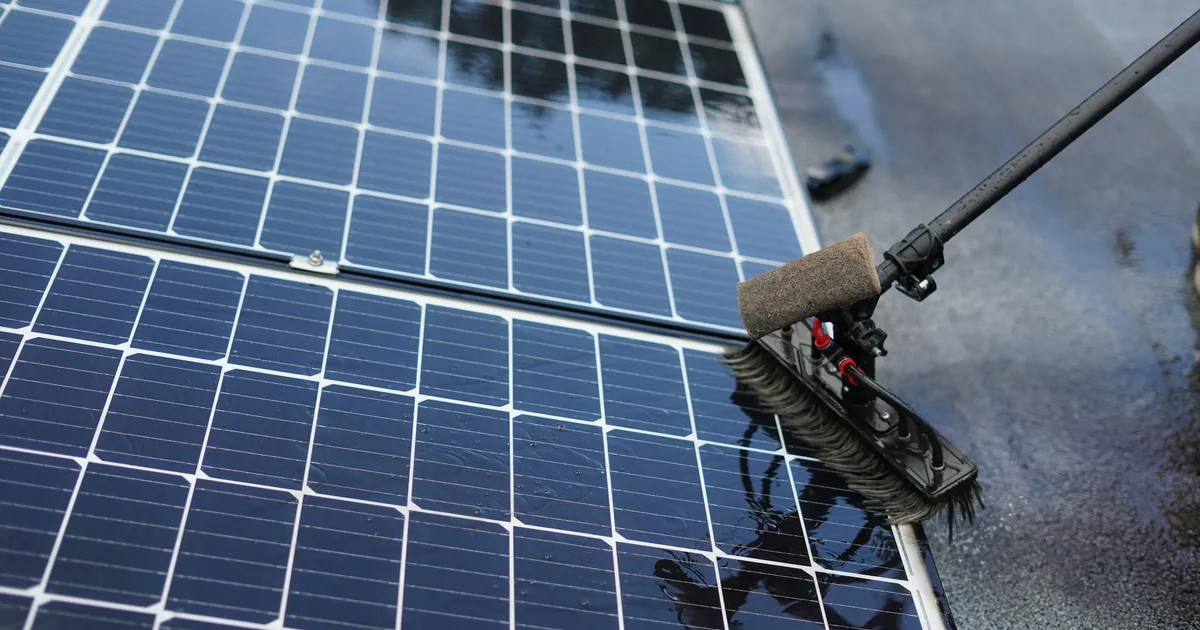
On the Costa Blanca, one or two cleans a year is sensible, plus an extra one after a heavy calima episode or muddy rain. Near the sea or open countryside, make it two.
How to do it properly:
- Early morning or at dusk, with the panel cold. Cold water on hot glass can cause damage.
- Water and a soft brush or mop, no harsh detergents and no scouring pads.
- No pressure washer: pressurised water damages the frame seals and the junction box.
- Never stand on the modules. Microcracks are invisible and you pay for them in output for years.
And a safety warning we always give: most accidents on domestic PV are not electrical, they are falls. If your roof is pitched, tiled, or has a low parapet, don't go up. That alone is reason enough to call someone.
A sensible annual service
For a domestic installation, one visit a year is enough: cleaning, per-string measurement, protection checks and terminal tightening, an inverter check and a report comparing output. It is cheap relative to what it protects — an installation running 15 % down for three years has lost more money than several services cost.
If your system already works well and what you want is to use more of what it generates, the two usual routes are moving loads to midday and considering storage: we cover that in solar self-consumption batteries in Alicante and, if you drive electric, in charging your car with solar panels.
In short
If your panels are producing less, start by comparing the same month across years and reading the monitoring per string. Then, in order of likelihood: dirt, new shading, an inverter stopped or derating from heat, a string down, protection tripped after a storm, degraded connections and — very often — a configuration or contract issue that has nothing to do with the panels.
We inspect, clean and repair self-consumption installations across Alicante and the Costa Blanca, including those installed by other companies. See our solar self-consumption service in Alicante, our solar battery storage service, or ask us for a no-obligation inspection.
Ready to switch to self-consumption?
We install self-consumption solar panels in Alicante and the Costa Blanca, legalise the system and prepare the paperwork for whichever incentives are in force.
See self-consumption solar panels