Physically, fitting an EV charger is an afternoon's work. What most people only find out when someone asks for it is that a charging point is a new electrical installation, with its own regulation and its own paperwork. And the paperwork is what decides whether you can claim the tax deduction, whether your insurer pays out if something happens in the garage, and whether the charger adds or subtracts value on the day you sell.
This guide explains what Spanish regulations require of a charging point in a home or garage in the province of Alicante, which document applies in each case — certificate, design report or full project — and the common Costa Blanca situations where the answer changes without the owner expecting it.
The rule that governs it: ITC-BT-52
Since 2014, EV charging installations have had their own technical instruction within Spain's Low Voltage Electrical Regulations: ITC-BT-52, approved by Royal Decree 1053/2014. The same decree amended other instructions, including the one that says when an installation needs a project (ITC-BT-04) and the one that says when it needs an initial inspection (ITC-BT-05).
You don't need to read it. But it helps to know it exists, because it is what separates a legal installation from a beefed-up socket. When an installer tells you "it can't be done like that", they are almost always quoting one of these four requirements:
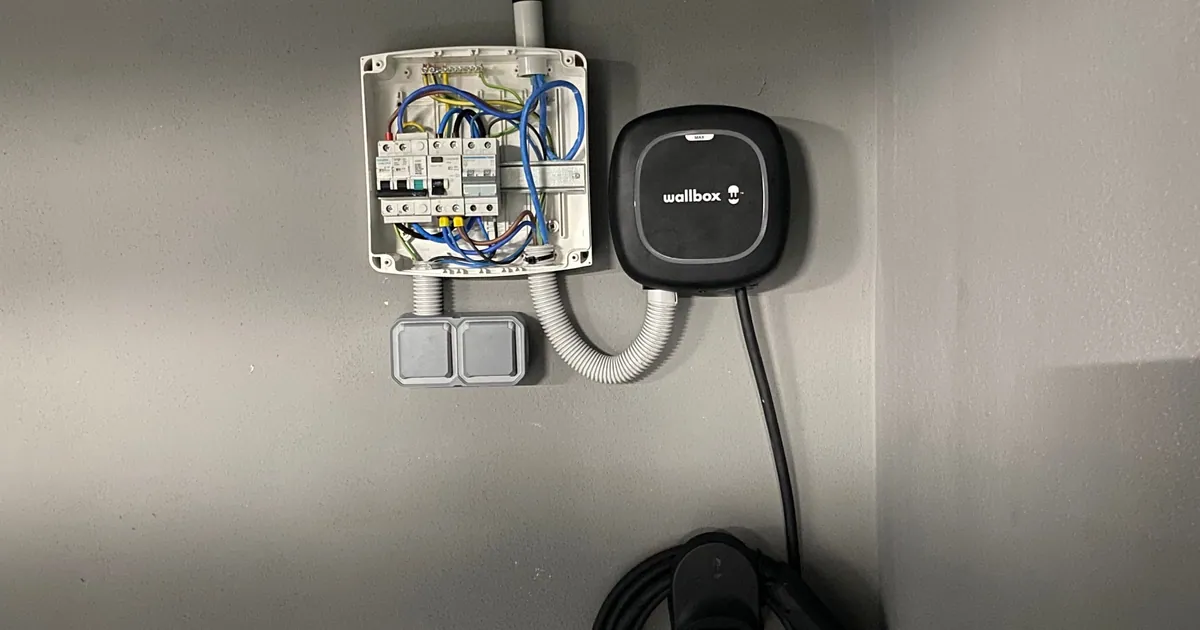
- A dedicated circuit. In a detached or semi-detached house the charger goes on its own circuit, which the regulation calls C13. If that circuit is single-phase, its installed power cannot exceed 9,200 W.
- Its own RCD for every connection point, rated 30 mA at most and at least Type A. It can sit in the consumer unit or be built into the charger, but it has to exist.
- Surge protection, against both temporary and transient overvoltages. The rule requires it for every circuit of the charging installation.
- A fixed position next to the parking space, in an enclosure, with sockets and connectors at least 60 cm above the floor.
None of this is exotic. But a charger hung off the storeroom circuit, with no RCD of its own and no surge protection, meets none of the four — and it is more common than you'd think when people call us to repair a charger that has stopped working.
The scheme comes first, and the scheme decides the paperwork
ITC-BT-52 does not describe one installation; it describes four possible schemes. Choosing one is not a technical footnote: it changes who pays for the electricity the car uses, whether the building's meter room has to be touched, and how much work is involved.
| Scheme | What it is | Where we see it in Alicante |
|---|---|---|
| 1 | Collective or trunk installation with a main meter and sub-meters per station | Community pre-installations, car parks on new developments |
| 2 | The charger runs off the same meter as the home | The usual option for a space in a communal garage, with a line run from your own meter |
| 3 | A separate meter just for the charging station | When there is a free module in the meter room and you want the consumption separate |
| 4 | Additional circuit from an existing installation | Villas and townhouses (C13 circuit, scheme 4a) or the garage's communal services (4b) |
In a villa or townhouse, the answer is almost always scheme 4a: a C13 circuit leaving your own consumer unit. It is the simplest case, and the one we walk through step by step in how we install a charger at home.
In a communal garage there are more options, and this is where the expensive mistakes are made. Hanging the charger off the garage lighting supply (communal services) looks convenient, but it means the community pays for your charging, and that ends in an uncomfortable owners' meeting. The right answer is usually a line from your own meter (scheme 2) or a new meter in a spare module of the meter room (scheme 3). Remember you don't need the community's permission, only to notify it — we cover that in EV charger in a communal garage.
Certificate, design report or project: which document applies
Every charging installation ends with the same document: the Electrical Installation Certificate (CIE) — the boletín — signed by an authorised installer and registered with the regional government (Generalitat). What changes with size and location is the technical document behind it:
- Design Report (Memoria Técnica de Diseño, MTD). The normal case for a home or a garage space. The authorised installer writes it, describing the circuit, cable size, protections and the chosen scheme.
- A project signed by a qualified engineer. Under ITC-BT-04 it is required for charging installations over 50 kW, those located outdoors over 10 kW, and any installation that includes mode 4 charging (DC fast charging), whatever its power.
- Initial inspection by an approved inspection body (OCA). ITC-BT-05 requires it for charging stations that need a project. A normal domestic installation does not.
So the vast majority of private chargers — 7.4 kW single-phase, or 11 kW three-phase inside a garage — are handled with a design report and certificate, with no project and no inspection. If you don't yet know which power suits you, start with which charger to choose: 7.4, 11 or 22 kW.
The case that surprises people most on the Costa Blanca: an outdoor charger
This is the detail almost nobody mentions. The project threshold is not the same indoors and out: a charging installation located outdoors needs a project from 10 kW.
On the Costa Blanca this matters far more than in an inland city, because a good share of the homes that ask us for a charger have no enclosed garage. They are villas in Jávea, Moraira or La Nucía with the car parked on the drive, under a pergola or against the façade. If you want a three-phase 11 or 22 kW charger there, the file stops being a design report and requires a project and its initial inspection, with the cost and lead time that adds.
That is why, on the site visit, we ask where the car sleeps before we talk about kilowatts. In many cases a 7.4 kW single-phase charger more than covers a private owner's daily driving, stays under the threshold and avoids the project. In others, the owner genuinely needs three-phase power, and the honest thing is to say so before starting and quote for all of it. What we don't do is fit 22 kW on the façade on a design report and hope nobody asks.
If the point sits somewhere debatable — a carport open on one side, a covered porch — whether it counts as "outdoors" is the engineer's call with the installation in front of them, and it is worth having that reasoning in writing.
Do you need to increase your contracted power?
Not necessarily, and it helps to separate two things that often get mixed up:
- Contracted power is what you pay your supplier for each month. Raising it is a contract change, although the distribution company may ask for an updated certificate if the new power exceeds what your installation is certified for.
- Installation capacity is what your wiring and consumer unit can carry. That is what the certificate validates.
With dynamic load management, the charger measures the household's consumption in real time and backs off when needed, so the car never trips the main switch. In most homes it lets you install a charger without raising your contracted power. We show the numbers in what power you need for a charger.
What the installer should hand you at the end
When the job is finished you should have, at a minimum:
- An itemised invoice, with equipment and labour shown separately.
- A registered Electrical Installation Certificate (CIE), carrying the authorised installer's number.
- The design report or, where it applied, the project and the initial-inspection certificate.
- The single-line diagram of the circuit: which RCD and which breaker protect the charger, and where they are.
- The charger's documentation and the configuration it was left with (maximum power, load management, scheduling).
If all you get is an invoice, the important part is missing. Spain's income-tax deduction for installing a charging point requires exactly the invoice and the installation certificate; without them, the saving disappears. It is explained in EV charger grants in 2026.
What if the charger is already fitted and was never certified?
We see it often: chargers bought online and fitted by a friend, or plugged into a circuit that already existed. It's no reason for alarm, but it is a reason to have it checked, for three practical reasons:
- Insurance. After a fire or damage in the garage, the loss adjuster's first question is whether the installation was done and certified by an authorised installer.
- The tax deduction. It cannot be claimed without an installation certificate.
- Selling or letting the home. An informed buyer, or their surveyor, will ask for the certificate covering the charger circuit. We cover the buyer's side in checking the wiring before you buy.
Regularising is usually straightforward if the work is sound: we inspect the circuit, add what is missing — nearly always the dedicated RCD or the surge protection — and issue the certificate. If the installation cannot be certified as it stands, we tell you the specific reason and quote for what needs correcting.
What you can do before you call
Three facts make the site visit much shorter and the quote far more accurate:
- Where the charger will go: enclosed garage, communal space, outdoors, open carport.
- Your contracted power, and whether your supply is single- or three-phase. It's on your electricity bill.
- A photo of your consumer unit and, in a block of flats, of the meter room.
With those we know in advance which scheme applies, whether your case needs a design report or a project, and whether load management makes sense. As a reference, EV charger installation in Alicante starts from €800 including the equipment; what pushes that price up or down is in how much it costs to install a charger.
Do it once, with the paperwork in order
We are authorised electrical installers in Alicante and across the Costa Blanca. We choose the right scheme with you, tell you from day one whether your installation needs a design report or a project, and hand over the registered certificate with complete documentation. If you are a community preparing the garage for several owners, see charging points for communities; for anything else about the certificate itself, our electrical certificate in Alicante page.
Write to us through the form with the three facts above and we'll reply with what your case needs.
This guide summarises ITC-BT-52 and the amendments to ITC-BT-04 and 05 introduced by Royal Decree 1053/2014. It is general information: the specific solution for each installation is determined by the authorised installer after seeing it.
Want to install a charger at home?
We install EV chargers in Alicante and the Costa Blanca, with installation certificate and a closed quote after the visit.
See EV charger installation